
By 2026, the digital landscape has shifted from static pages to "living" interfaces. We are no longer just building websites; we are constructing intelligent ecosystems where Artificial Intelligence (AI) and Web3 technologies converge to create experiences that are predictive, personalized, and sovereign.
For brands, developers, and creators, understanding this convergence is no longer optional—it is the baseline for relevance. The era of the "brochure website" is dead. In its place is the "Agentic Web"—sites that don't just display information but actively help users achieve their goals through automated reasoning and decentralized identity.
Here is what you need to know about the state of AI and decentralized design in 2026.
1. The Rise of "Perceptive" Interfaces
The most immediate change in 2026 is the death of the generic user journey. In the early 2020s, personalization meant swapping a homepage banner based on cookies. Today, AI drives "Perceptive UI"—interfaces that reconfigure themselves in real-time based on user intent and on-chain history.
When a user connects their wallet, the website shouldn’t just show a generic "Welcome" message. AI analysis of public on-chain data (which the user consents to share via their wallet connection) allows the site to instantly understand the user's context. Is this a high-frequency trader? A long-term holder? A governance participant?
For example, a DeFi protocol in 2026 doesn't force a novice user to navigate complex trading charts. Instead, the AI detects a "newbie" wallet profile and simplifies the interface, highlighting educational content and "one-click" staking options. Conversely, a "whale" wallet triggers a pro-interface with advanced depth charts and arbitrage tools. This level of Web3 Web Design creates a sense of immediate belonging and utility that static Web2 sites never could.
2. Generative UI (GenUI) and the End of Templates
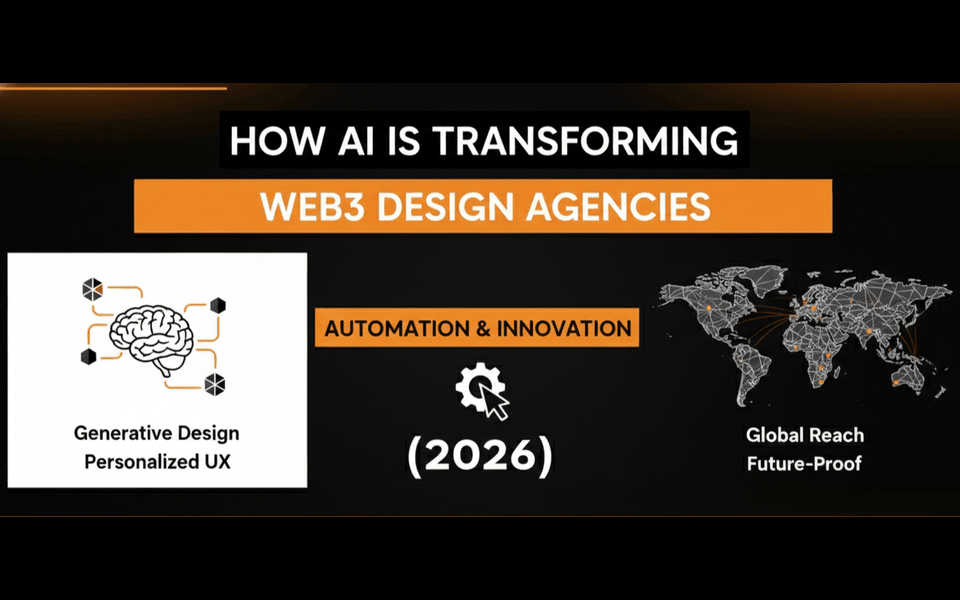
The rigid templates of the past have given way to Generative UI (GenUI). In 2026, designers define "systems" rather than "pages." They create the constraints—typography, color palettes, component libraries—and AI agents assemble the layout on the fly to suit the user's immediate need.
If a user lands on a DAO governance page asking, "What proposals affect my voting power?", the AI doesn't just link them to a forum. It generates a custom dashboard displaying only the relevant proposals, visualizes the impact on their specific token holdings, and offers a "Vote" button right there. The interface is summoned by intent, not hard-coded by a developer.
This shift requires a new mindset. We are moving away from pixel-perfect mockups toward "intent-based design." The goal is to reduce friction to zero. If the user wants to swap tokens, the interface should morph into a swap terminal. If they want to learn, it should become a wiki.
3. The "Human-Readable" Blockchain
One of the biggest hurdles for Web3 adoption was the terrifying complexity of transaction hashes and hex codes. In 2026, AI has finally solved the "readability gap."
AI agents now act as interpreters between the user and the smart contract. Before a user signs a transaction, an embedded LLM (Large Language Model) analyzes the contract code and presents a plain-English summary of exactly what will happen: "You are granting this contract permission to spend up to 500 USDC. This is a one-time approval."
This creates a standard of safety and clarity that was previously impossible. It is the core of modern Web3 Ui Ux Design, transforming anxiety-inducing crypto transactions into clear, confident agreements. Trust is no longer just about cryptography; it’s about clarity.
4. Privacy-First Personalization
The "Privacy Paradox" of Web2—where you had to sell your data to get a good experience—has been solved by the Web3 + AI stack. In 2026, we utilize "Edge AI," where the artificial intelligence models run locally in the user's browser, not on a central server.
The AI analyzes the user's wallet activity and browsing behavior on their device to personalize the experience, but that data never leaves the user's possession. The website receives only the insight (e.g., "show the VIP tier"), not the raw data. This allows brands to offer hyper-personalized experiences without tracking cookies or GDPR nightmares. It is the ultimate synthesis of utility and sovereignty.
5. Aesthetics in 2026: The "Organic Digital"
Visually, 2026 is rebelling against the cold, corporate "SaaS" look of the early 20s. We are seeing a resurgence of "Organic Digital" aesthetics.
Bento Grids & Modular Layouts: Inspired by the modularity of blockchain blocks, content is organized in flexible, bento-box style grids that can resize and reshuffle based on importance.
Kinetic Typography: Text is no longer static. It reacts to the cursor, scrolls with weight, and acts as a primary visual element, replacing heavy imagery to keep load times instant.
Glassmorphism & Depth: To visualize the "layers" of the blockchain (L1, L2, dApps), designers use glassmorphism and subtle 3D depth to show hierarchy. It feels tactile, like looking through layers of digital glass.
Micro-Interactions: Every click, hover, and transaction is rewarded with subtle haptic or visual feedback. When a transaction confirms, the UI doesn't just say "Success"; it celebrates with a micro-animation that reinforces the feeling of value transfer.
6. The Agentic Workflow
Perhaps the most profound shift is that websites in 2026 are "Agentic." They don't just wait for you to click buttons; they offer to do the work for you.
Imagine browsing an NFT marketplace. Instead of manually filtering by traits and price, you simply type (or say), "Find me a blue-chip PFP under 5 ETH with a rarity score in the top 10%." The site's AI agent scans the listings, verifies the metadata, checks the contract security, and presents three options. It acts as a concierge, not a catalog.
This requires a specialized web3 design agency to implement. These agencies are no longer just hiring graphic designers; they are hiring prompt engineers, smart contract auditors, and AI architects to build these "headless" conversational interfaces that sit on top of robust blockchain protocols.
7. Strategic Considerations for Brands
For businesses entering this space, the bar has been raised. A generic template suggests a generic project. To compete in 2026, your digital presence must signal "competence" and "future-readiness."
Speed is Trust: In a world of instant settlement, a slow website is a red flag. AI-optimized code splitting ensures sites load instantly, even on mobile networks.
Mobile-First is Now "Mobile-Only": With the rise of mobile wallets and "super apps," 90% of Web3 interaction happens on a phone. Desktop design is a secondary concern.
Community is the UI: Social proof is embedded directly into the interface. Governance votes, community sentiment, and treasury health are visualized in real-time, making the community's pulse part of the design itself.
8. Choosing the Right Partner
Navigating this complexity is difficult for internal teams accustomed to traditional Web2 stacks. The integration of local LLMs, wallet connect standards (like WalletConnect v5), and dynamic on-chain data requires a partner who lives at this intersection.
You are not just looking for a "designer." You are looking for a strategic partner who understands tokenomics, AI behavior, and user psychology. Finding the right Web3 Website Design agency is the critical step in bridging the gap between complex backend protocol and a seamless, "magic" frontend experience.
Conclusion
The website of 2026 is a portal, a tool, and an assistant all in one. It respects the user's data, anticipates their needs, and simplifies the complex reality of the blockchain. As AI and Web3 continue to mature, the screen fades away, leaving only the intent and the action.
For brands, the message is clear: Stop building pages. Start building intelligent, adaptive environments. The future isn't just about being online; it's about being alive, responsive, and radically helpful.




Write a comment ...